Most people who visit Jordan see Petra, Wadi Rum, and the Dead Sea — and leave satisfied. They should not be. The hidden gems in Jordan that exist beyond this well-worn triangle represent a completely different version of the country: quieter, more complex, and in several cases more historically significant than the sites that appear on every travel poster. Getting to them requires planning, a reliable vehicle, and ideally a guide who has been there before. What they deliver in return is the rare experience of standing somewhere extraordinary without a crowd.
Beyond Petra: Why the Hidden Gems in Jordan Transform Any Itinerary
Jordan is a small country with an implausible density of history. The mainstream itinerary covers it efficiently but selectively — Petra is genuinely unmissable, Wadi Rum earns every photograph — but the sites that remain off most travelers’ radars are not lesser versions of the famous ones. They are different categories of experience entirely.
Umm Qais looks north over the Sea of Galilee from a Greco-Roman city that most visitors to the region have never heard of. Um er-Rasas contains Byzantine mosaics of such detail and preservation that UNESCO has designated the site a World Heritage property, yet on most days you can walk through it with almost no one else present. Explore our private Jordan day tours that include these sites as primary destinations rather than afterthoughts. For travelers already planning a Petra trip.
Um er-Rasas: the Mosaic Site That Should Be Famous
The site of Um er-Rasas in central Jordan contains some of the finest Byzantine and early Christian mosaics in the world — floor panels of extraordinary complexity depicting city maps, hunting scenes, fishing on the Nile, and geographical representations of the Holy Land that date from the 6th to 8th centuries AD. The main mosaic in the Church of Saint Stephen alone stretches over 15 meters and contains detailed representations of cities across Jordan, Palestine, and Egypt, each labeled in Greek, with a level of artistic precision that is genuinely stunning.
The site is not difficult to visit, but it requires driving into the central Jordanian plateau where road signs become infrequent and the landscape flattens into a semi-arid expanse that most tour itineraries skip entirely. The reward for making the effort is access to a UNESCO World Heritage Site that receives a fraction of the visitors it deserves. Book a guided Um er-Rasas day trip from Amman with a specialist who can read the mosaic inscriptions and explain the theological context that makes these panels more than decorative.
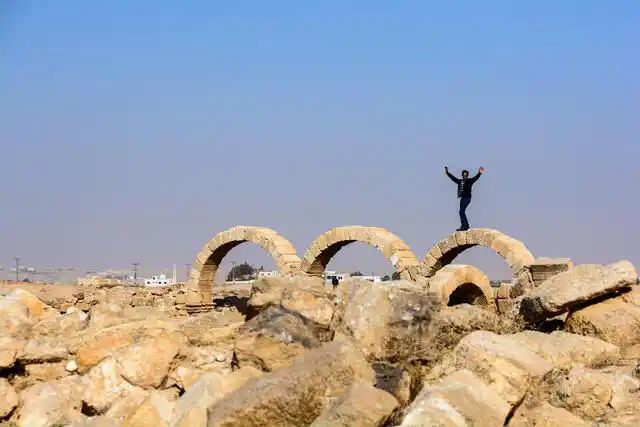
Umm Qais: Greco-Roman Ruins with a View That Stops Conversations
Umm Qais — ancient Gadara — sits on a basalt plateau in the far northwest of Jordan, and the view from its western terrace is one of the most geopolitically charged panoramas in the Middle East: the Sea of Galilee to the north, the Golan Heights rising to the northeast, the Jordan Valley descending to the south. The ruins themselves are substantial — a colonnaded street, two theatres, a Byzantine atrium church, and the remains of a city that was one of the ten cities of the Decapolis league in the Roman period.
What makes Umm Qais special is the combination of the ruins and the view, experienced almost always in near-solitude. The small museum on-site contains some excellent Roman statuary. The village of Umm Qais next to the ruins has a handful of good restaurants where you can eat a long, slow lunch looking out over three countries simultaneously.
The drive from Amman takes about 90 minutes through the northern highlands — the road is good, the landscape increasingly green as you approach — and the site works best as a full-day trip with time built in for both archaeology and the view. Reserve a private Umm Qais day tour from Amman with transport and a licensed guide included.
Want to see Jordan beyond the postcards? Flow Travel’s local specialists build itineraries around the sites that reward curiosity — with private transport, expert guides, and zero guesswork. Contact our Jordan team for a personalized hidden gems itinerary
Wadi Numeira vs Wadi Mujib: Canyoning Without the Crowds
Wadi Mujib is Jordan’s most famous canyon and, on busy days, feels like it. Wadi Numeira, 15 kilometers to the south, offers a comparable canyon experience — narrow slot sections, wading through cool water, scrambling over polished limestone — with a fraction of the visitors and none of the organized tourist infrastructure that makes Mujib feel, at peak hours, like a theme park.
Numeira requires more preparation than Mujib precisely because it lacks that infrastructure. There are no lockers, no life jackets for rent, no snack stands at the exit. You bring what you need, you navigate with someone who knows the canyon’s behavior after rain, and you exit through a landscape that has not been optimized for tourism. That is entirely the point.
Essential gear for remote wadi hiking in Jordan:
- Water shoes or old trainers that can get wet — sandals are inadequate
- Dry bag for phone, documents, and anything that cannot get soaked
- Minimum two liters of water per person beyond what the wadi provides
- A light change of clothes for the drive back
Feynan Ecolodge and Dana Village: Off-Grid Jordan Done Properly
The Dana Biosphere Reserve is Jordan’s largest nature reserve and one of the most ecologically diverse areas in the Middle East — four distinct bio-geographical zones descend from the highland village of Dana to the Wadi Araba desert floor, supporting over 800 plant species and 200 bird species across the transition. Most visitors who make it to Dana spend a few hours and drive on. The ones who stay understand why it appears on every serious list of the best experiences in the country.
Dana Village itself is a restored Ottoman-era stone settlement perched on the edge of the escarpment, with views down into the reserve that are best at sunrise and late afternoon when the light in the canyon is horizontal and deeply colored. Feynan Ecolodge, reachable only by a two-hour guided hike or 4×4 track into the valley below, operates entirely without electricity from the grid — solar powered, candlelit after dark, with Bedouin staff from the local community and food grown in the surrounding gardens.
The night sky at Feynan, in the absence of any light pollution, is among the clearest in Jordan. Book a two-night Feynan Ecolodge stay through Flow Travel with guided hiking between Dana and the lodge included.
Quseir Amra and the Desert Castles: Early Islamic Art in the Eastern Desert
The Eastern Desert of Jordan contains a chain of early Islamic structures — hunting lodges, caravanserais, and bathhouses built by the Umayyad caliphs in the 7th and 8th centuries — that represent some of the most important early Islamic art in existence. Quseir Amra, the most significant of these, is a UNESCO-listed bathhouse whose interior walls are covered in extraordinary frescoes: hunting scenes, bathing women, the signs of the zodiac, and — most remarkably — a map of the known world with personifications of the great empires of the time, rendered in a naturalistic style that predates most Islamic figural art by centuries.
The site sits about 85 kilometers east of Amman on a road that crosses a flat, sparse desert landscape with almost no other traffic. The combination of remoteness and the quality of what waits at the destination creates a specific kind of travel satisfaction that organized tour circuits almost never deliver.
The Jordan most travelers miss is the Jordan worth finding. Flow Travel builds private itineraries around the sites on this list — with licensed guides, comfortable transport, and local knowledge that no guidebook contains. Start planning your hidden gems Jordan itinerary today