Jawa is one of the most remarkable and least-known archaeological sites in the Middle East. Hidden deep within the barren black volcanic landscape of eastern Jordan, this ancient settlement holds a record that few people know about: it is home to the oldest known dam in the world, built over 5,000 years ago. For history enthusiasts, archaeology lovers, and off-the-beaten-path travelers, Jawa offers a window into a civilization so advanced — and yet so mysterious — that it continues to baffle researchers to this day.
Where Is Jawa Located?
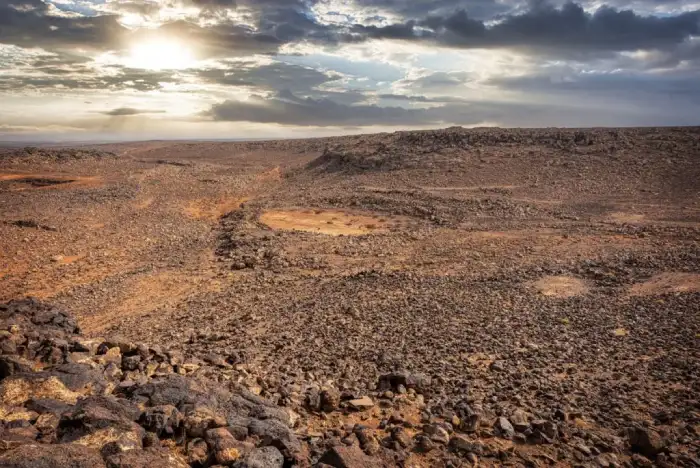
Jawa is situated in the Harrat al-Shamah, also known as the Black Desert, in the eastern region of Jordan. This vast basalt plateau stretches across northeastern Jordan into Syria and Saudi Arabia, and is one of the driest, most inhospitable landscapes in the entire Middle East.
The site lies approximately 7 km beyond Qasr Deir Al Kinn, perched on a rocky ledge alongside the Wadi Rajil — a seasonal watercourse that played a vital role in the settlement’s survival. Getting there is an adventure in itself, involving long stretches of unpaved desert road, making Jawa one of Jordan’s most remote and rewarding destinations.
A City Born at the Dawn of Civilization
Jawa is considered Jordan’s earliest proto-urban settlement, dating back to the late 4th millennium BC — roughly 3,200–3,000 BC, during the Early Bronze Age. This places it among the oldest planned urban centers in the ancient world, contemporaneous with the early cities of Mesopotamia and pre-dynastic Egypt.
The city covered a total area of approximately 10 hectares and was divided into two distinct zones:
- The Upper Town — a heavily fortified citadel with walls rising up to 6 meters above bedrock, constructed from roughly coursed black basalt with a rubble core. This area contained at least six gates and served as the administrative and defensive heart of the settlement.
- The Lower Town — a residential expansion that grew from a temporary labor camp built to house the workers who constructed the upper fortress. This area had at least eight gates and was enclosed by its own fortification walls.
Together, these two zones paint a picture of a highly organized society with a clear division of labor, social hierarchy, and urban planning capabilities far ahead of their time.
Who Built Jawa? The Enduring Mystery
One of the most compelling aspects of Jawa is that the identity of its builders remains unknown. Despite decades of archaeological investigation, researchers have not been able to definitively link the Jawaites to any known ancient culture or migration pattern.
What is clear is that they arrived with sophisticated knowledge of construction, hydrology, and urban organization — skills that allowed them to establish a thriving city in one of the harshest environments on Earth. Some scholars suggest they may have migrated from more fertile regions to the north or west, driven by climatic or political pressures, though no consensus has been reached.
The World’s Oldest Dam: Jawa’s Most Extraordinary Feature
Without question, Jawa’s greatest claim to fame is its ancient water management system — and at its center, a masonry gravity dam that is recognized as the oldest known dam in the world.
Age and Construction
The main dam at Jawa dates to approximately 3,000 BC, predating other famous ancient dams by centuries. It was engineered as a masonry gravity dam — a structure that uses its own weight to resist the pressure of water — demonstrating a level of hydraulic engineering knowledge that is staggering for its era.
A Complete Hydrological Network
The dam was not a standalone structure. It was the centerpiece of an extraordinarily sophisticated water supply system that included:
- Over 8 km of stone canals channeling seasonal runoff
- Multiple diversion structures to redirect floodwaters
- Several smaller dams along the Wadi Rajil
- Reservoirs and cisterns for water storage
This entire network was engineered to capture the scarce winter rains and store water for use throughout the dry season — a critical survival strategy in a region where natural springs are rare and groundwater is largely inaccessible.
The scale and complexity of this system reveal a community with deep knowledge of hydrology, topography, and long-term resource management. It remains one of the most impressive feats of prehistoric engineering ever discovered.
Architecture and Daily Life in Jawa
Houses and Domestic Spaces
Jawa’s residential areas were densely packed with irregularly shaped houses that reflected both practical necessity and the constraints of the rocky terrain. These homes were:
- Partly subterranean, dug into the ground for insulation against the desert heat and cold
- Built with stone foundations and mud-brick superstructures
- Finished with plastered walls and mud floors
- Roofed with oak beams sourced from the nearby Jabal Druze mountains, covered with reeds and packed mud
This combination of building techniques — stone, mud-brick, timber, and plaster — shows that Jawa’s inhabitants were resourceful builders who used every available material to create durable, comfortable dwellings.
Fortifications
The defensive architecture of Jawa is one of its most visually striking features. The upper fortification — with walls reaching 6 meters in height — is the strongest and most intact. The sheer number of gates (14 in total across both towns) suggests that movement of people and goods was highly regulated, possibly reflecting complex social and economic organization.
The Fall of Jawa: Destruction and Abandonment
Despite its impressive construction and sophisticated infrastructure, Jawa’s story ended abruptly.
Archaeological evidence shows that after only a few decades of occupation, the city was attacked. Breached walls and widespread destruction visible in the archaeological record point to a violent assault that overwhelmed the settlement’s defenses. Some inhabitants may have survived and continued to occupy parts of the site for a short time afterward, but the city never recovered.
Without organized maintenance, the water system failed. In an environment where survival depends entirely on managed water supply, this was catastrophic. The population dispersed, and Jawa was abandoned.
Over the following millennium, different communities reoccupied the site on a small scale at various points, attracted perhaps by the remnants of the water infrastructure or the shelter of the standing walls. But none of these later occupations lasted, and eventually Jawa was deserted for good.
For approximately 4,000 years, it has stood silent and largely forgotten — an enigmatic ruin swallowed by the Black Desert.
Visiting Jawa Today
Jawa is not on most tourist itineraries, and that is precisely what makes it so special. Visitors who make the journey are rewarded with a profoundly atmospheric experience — walking through the ruins of a 5,000-year-old city with almost no other tourists in sight.
What to See
- The ancient dam — the star attraction, a tangible piece of the world’s oldest hydraulic engineering
- The upper and lower town fortifications — massive basalt walls that still convey a sense of power and scale
- The northwest ridge — a rewarding climb that leads to a reused ancient reservoir and panoramic views over the wadi
- The hilltop — the highest point of the site, offering sweeping views of the Black Desert landscape
Practical Tips for Visitors
- Getting there: Jawa requires a 4WD vehicle and ideally a local guide familiar with the desert tracks. It is located approximately 7 km beyond Qasr Deir Al Kinn in the Harrat al-Shamah.
- Best time to visit: October to April, when temperatures are manageable. Summer heat in the Black Desert is extreme and potentially dangerous.
- What to bring: Plenty of water, sun protection, sturdy footwear, and a fully charged phone or GPS device. There are no facilities at the site.
- Combine with other sites: Jawa pairs well with other eastern Jordan destinations such as the Azraq Wetland Reserve, Qasr Amra (a UNESCO World Heritage Site), and Qasr al-Hallabat.
Why Jawa Matters: A Legacy Written in Stone
Jawa is more than just an archaeological curiosity. It is a testament to the ingenuity and resilience of early human civilization — proof that people living in one of the world’s harshest environments could build a city, engineer a water supply system, and sustain a community against formidable odds.
The world’s oldest dam, standing at Jawa, is not just a Jordan landmark. It is a milestone in human history — evidence that the impulse to manage nature, build communities, and engineer solutions to environmental challenges is as old as civilization itself.
That this place remains so little known to the wider world makes it all the more precious. Jawa deserves its place alongside the great archaeological wonders of the ancient Near East — not as a footnote, but as a headline.
Key Facts About Jawa, Jordan
Feature | Detail |
Location | Harrat al-Shamah (Black Desert), Eastern Jordan |
Period | Late 4th millennium BC (Early Bronze Age, c. 3,200–3,000 BC) |
Settlement Area | ~10 hectares |
Dam Age | c. 3,000 BC (oldest known dam in the world) |
Dam Type | Masonry gravity dam |
Water System | 8+ km of canals, diversions, dams, and reservoirs |
Wall Height | Up to 6 m above bedrock |
Number of Gates | 14 (6 upper town, 8 lower town) |
Builders | Unknown |
Abandoned | After attack and water system failure (~2,900 BC) |
Jawa is a site of significant archaeological importance. Visitors are encouraged to respect the ruins, avoid removing any stones or artifacts, and tread carefully to help preserve this irreplaceable piece of human heritage.